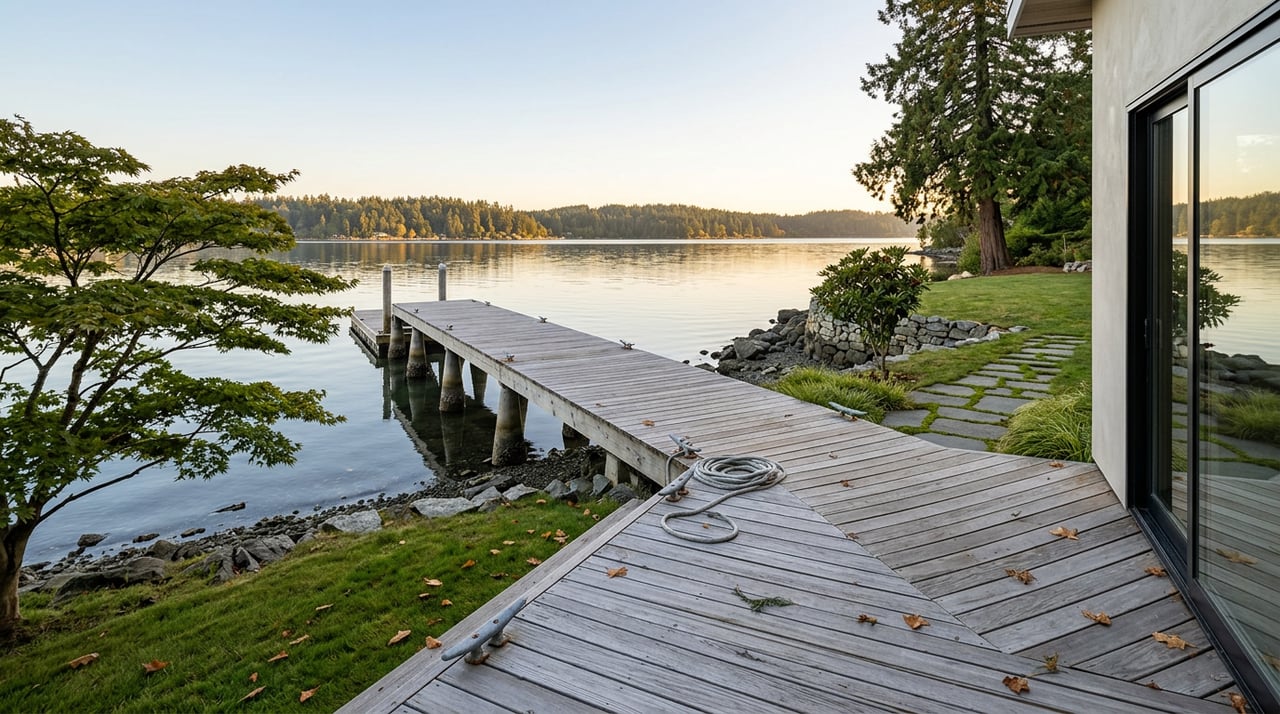
The dock inspection on a Lake Washington waterfront home usually takes ten minutes. Someone walks out, taps a piling, notes some soft decking, and writes "recommend repair" in a report that otherwise reads like good news. Buyer and seller both nod. It sounds like a contractor problem, the kind you solve with a bid and a few weekends in the summer.
It isn't. A dock on Lake Washington sits inside one of the most tightly layered permitting zones in King County, and the paperwork behind "recommend repair" can outlast the escrow period by a year or more. If you're buying or selling on the water in Medina, Clyde Hill, Yarrow Point, Hunts Point, or West Bellevue, the dock is not a fixture you inherit along with the house. It's a separate regulatory relationship you're stepping into, whether anyone mentions it at closing or not.
Whose dock is it, really
Start with an assumption most waterfront buyers carry without ever testing it: that an existing single-family dock, once built, is simply theirs to maintain like a roof or a fence. Under King County's Shoreline Master Program, that's not quite how the county sees it. A pier or dock built solely for the use of one single-family residence is not an outright permitted use on King County shorelines. Joint-use docks, shared piers, or floating moorage buoys are the arrangement the county's own rules prefer, and a private single-family dock is allowed only when those shared alternatives aren't workable for the site.
This matters because it changes the conversation from "can I fix my dock" to "can I justify keeping a private dock at all," at least on paper. In practice, most existing private docks on Lake Washington get treated as legal nonconforming structures, repaired under separate maintenance provisions rather than rebuilt from scratch. But the moment a repair crosses into replacement, expansion, or new construction, the county is evaluating the request against a rule that doesn't automatically favor a private, single-owner dock.
The same 200-foot band that governs the dock also governs the beach, the bulkhead, and the lawn behind it. Any structure built on or within 200 feet of a lake counts as shoreline jurisdiction, which means a failing bulkhead or a new stretch of retaining wall triggers the identical review process as the dock itself.
The permit stack, agency by agency
No single office issues "the dock permit." Depending on the scope of work, a straightforward re-decking can involve as many as four separate approvals, each with its own agency, its own timeline, and its own reason for existing.
| Agency | What it reviews | Typical processing window |
|---|---|---|
| Local shoreline permitting (King County or the relevant city hall) | Shoreline Substantial Development Permit, triggered once a project's improvement value crosses a threshold set in local code (King County's is roughly $8,500) within 200 feet of the lake | 120 days per King County's summary page, though the county's own detailed permit guidance says the process generally runs six months to a year |
| Washington Department of Fish and Wildlife | Hydraulic Project Approval for any work that disturbs the lakebed, including pile removal, pile replacement, and float work | Typically decided within 45 days of a complete application |
| U.S. Army Corps of Engineers | Federal authorization when work affects navigable waters, dredging, or new piles | Varies, though a regional general permit exists for qualifying dock projects on Lake Washington |
| Washington Department of Ecology | Section 401 water quality certification, required alongside federal review on qualifying projects | Runs in parallel with the Corps' timeline |
Every one of these reviews can run at the same time in theory. In practice, most contractors sequence them, because the local shoreline office wants its application complete before it will finish review, and WDFW wants a project description that already reflects whatever the local shoreline permit has required.
Worth separating here: Medina, Clyde Hill, Yarrow Point, and Hunts Point each run shoreline permitting through their own city hall rather than through King County's Department of Local Services. What doesn't change from one city hall to the next is the underlying category of permit and its statutory trigger, since every one of these local programs implements the same state Shoreline Management Act. King County happens to publish the most detailed account of how that category actually behaves once an application is filed, which makes its own numbers the clearest window into the pattern.
The number King County's own website doesn't agree with itself on
Here's the detail that should change how you plan a dock project, not just how you read one. King County's public-facing shoreline permit page lists processing time for a Shoreline Substantial Development Permit as 120 days. The county's own detailed Shoreline Substantial Development Permit information document, the one applicants actually work from, states plainly that the process generally takes six months to a year, provided no appeals are filed and no additional information is required.
Those two numbers come from the same agency, describing the same permit. The gap between them isn't a typo. It's the difference between a best-case estimate for a clean, uncontested application and the realistic range once you account for the twenty-one-day comment period, the required notice board posted on the property, and the very common request for additional information that resets the clock. If you or your contractor budget from the 120-day figure, you're planning around the version of this process that rarely happens.
The building season is shorter than the permit season
Even after every approval is in hand, Washington's Hydraulic Code doesn't let contractors work the lakebed whenever the calendar is open. State rules require WDFW to specify an authorized work window on every Hydraulic Project Approval it issues, tied to when fish life at that specific address is least vulnerable, and that window covers specific months rather than the full construction season. Pile driving outside those approved months isn't just discouraged. It's not authorized, regardless of what your other permits say.
Stack that seasonal window against a shoreline permit timeline that can run past six months, and a project that starts in the fall may not see its first piling driven until the following summer. That's the real math behind "recommend repair" on a dock inspection report. It isn't a repair estimate. It's the opening line of a project that touches four regulatory calendars before it touches a single board.
There's a faster path for some projects. The Army Corps of Engineers offers an express review for dock work that meets specific design criteria, reducing federal review time considerably for qualifying repairs. It's worth asking a contractor early whether a project can be scoped to fit that pathway, because the difference between a compliant, minimal-footprint design and an expanded one can be the difference between one summer and two.
What this actually means if you're buying or selling
For sellers, the honest move is to know your dock's permit history before you list, not after an inspection surfaces a question you can't answer. A permitted, joint-use-eligible dock is a genuine asset. An undocumented private dock that predates current rules can still be a fine amenity, but buyers deserve to know which situation they're stepping into.
For buyers, a few questions belong on the list before you write an offer on anything with a dock, a bulkhead, or a seawall:
- Does the seller have permit records for the existing dock, or was it built before current rules and never formally reviewed?
- Is any planned repair a simple maintenance item, or does it cross into the kind of substantial development that triggers a full Shoreline Substantial Development Permit?
- If work is needed, has anyone checked whether the project can meet the Army Corps' express review criteria, or is it headed for the standard, slower path?
- What does the county's detailed permit guidance say the realistic timeline is, not just the summary page?
None of these questions should stall a good offer. They should shape how you sequence your plans after closing, especially if a new dock, an expanded one, or bulkhead work is part of why you wanted the property in the first place.
This is the kind of detail that rarely shows up in a listing description, and it's exactly where four decades spent alongside a Northwest architect changes how a transaction gets handled. At Mary Nelson, permit history and construction realities get evaluated the same way the house itself does, before they become a surprise mid-transaction.
A few questions worth asking before you assume
Does this apply to a dock I'm not planning to touch? No. If you're not proposing new construction, repair, or expansion, none of these reviews are triggered. The rules apply to the work, not to ownership of an existing structure.
What about a bulkhead or seawall instead of a dock? The same shoreline jurisdiction and the same permit stack apply. Any structure within 200 feet of the lake with improvement value above the threshold is reviewed the same way, whether it's overwater or onshore.
Does Medina follow different rules than unincorporated King County waterfront? Cities within the Eastside shoreline, including Medina, administer their own shoreline master programs, but they operate under the same state Shoreline Management Act and the same WDFW Hydraulic Code that governs the rest of Lake Washington. The agency contacts differ. The underlying framework doesn't.
If you're weighing a waterfront purchase or preparing to list one on Medina, Clyde Hill, Yarrow Point, Hunts Point, or Bellevue's Lake Washington shoreline, let's connect before the permit questions become the deal's biggest unknown.