On March 28, 2026, a train ran across Interstate 90 for the first time in the history of the Puget Sound region, carrying passengers over a floating bridge on rails, something no transit system in the world had done before. Sound Transit's press materials called it historic. Local officials called it a turning point. Every real estate blog covering the Eastside published some version of the same sentence within the month: light rail has arrived, and home values near the stations are about to move.
That sentence is only half true, and the half that's missing is the more useful half for anyone actually comparing Bellevue to Mercer Island right now. A train stopping somewhere doesn't create housing. It creates access to housing that already exists, or doesn't. Whether a station turns into a genuine value driver depends less on the schedule Sound Transit publishes and more on what the city around that station has allowed to get built, which is a very different question, and the two ends of this new line answer it in almost opposite ways.
What actually opened in March
The full 2 Line, still widely called East Link, runs 14 miles and ten stations from Seattle's International District to Redmond's Overlake area. The Eastside portion opened first, in phases: South Bellevue to Redmond Technology Station went live in April 2024, with stops at East Main, Bellevue Downtown, Wilburton, Spring District, and Overlake Village. Two more Redmond stations, Marymoor Village and Downtown Redmond, opened in May 2025. The piece everyone was waiting on, the seven-mile Crosslake Connection that finally threads the line across I-90 to Seattle, opened this past March, adding two new stations along the way: Mercer Island and Judkins Park.
That last segment is the one worth sitting with. Mercer Island Station sits in the median of I-90, just north of the island's Town Center, and it put a train stop on an island that had never had one. The ride to Bellevue Downtown now takes about ten minutes. The ride to Seattle's International District takes about the same. Trains run every eight minutes at peak. For a household with one partner working in each city, that's a genuinely rare piece of geography: a single address with a short, direct, car-free commute in both directions.
That's the part of the story every headline got right. The part most of them skipped is what Mercer Island's own zoning has allowed to happen around that access.
The zoning fight that predates the train by a decade
Mercer Island's Town Center has added just 549 housing units since 2010, according to reporting from The Urbanist, with only one additional project, adding 146 more homes, currently under construction. That's a strikingly small number for a neighborhood built directly around a transit station that had been on the region's map for years before it opened.
Part of the reason traces back to 1995, when the city adopted its Town Center District Development and Design Requirements, capping building heights at five stories at the peak of the zone and stepping down to two stories in surrounding blocks. Those caps held for nearly three decades. A 2015 proposal from developer Hines, a five-story building meant to add at least 150 homes and a full-line grocery store near where the station would eventually sit, ran into organized opposition from a homeowner group called Save Our Suburbs, which pushed for a building moratorium and a costlier redesign. The project stalled for years and eventually returned in a scaled-back form, now known as the Lunara project, with a smaller package of public benefits than originally proposed.
The city has since raised height limits modestly. Ordinance 24C-18, effective at the end of 2024, lifted the cap in the TC-45 Plus and TC-57 subareas near the station from five stories to seven. But the bigger shift is coming from outside the city rather than from within it. A 2025 ruling from the state's Growth Management Hearings Board found Mercer Island's 2024 Comprehensive Plan insufficient on affordable housing and transit-oriented development requirements, which put the city under a legal deadline, July 31 of this year, to adopt a compliant Station Subarea Plan. That deadline has now come and gone, and the plan is meant to be the first of two phases, with a second phase tied to the state's 2025 transit-oriented development law following in 2027 and the area around the station expected to keep evolving through 2029.
In other words, the zoning capacity to actually build near Mercer Island's brand-new station is arriving on a schedule set by state mandate, roughly a decade after the transit line itself was approved by voters.
What that looks like next to Bellevue's stations
Compare that to what's happening around Bellevue's six stops on the same line. The Wilburton, Spring District, and Bel-Red corridor together account for roughly 14,000 housing units either recently completed or currently in the development pipeline. Downtown Redmond has added about 5,300 homes over the past two decades, and Redmond's Overlake neighborhood carries roughly 8,000 more in the pipeline or recently delivered. These aren't neighborhoods waiting on a court order to unlock capacity. They were already zoned, planned, and building well before the trains started running.
| Mercer Island (1 station) | Bellevue's Wilburton / Spring District / Bel-Red corridor | |
|---|---|---|
| Housing added near station since 2010 | 549 units, plus 146 under construction | Roughly 14,000 units built or in pipeline |
| Zoning ceiling near station | 5 to 7 stories (raised Dec. 2024) | Higher-density, transit-oriented zoning already in place |
| Land available to grow | None. 5 square miles, I-90 the only road access | Open corridor of former light-industrial and low-rise land |
| Current legal status | Faced a state deadline to adopt a compliant subarea plan by July 31, 2026 | Not under a comparable mandate |
That table isn't a case against Mercer Island. It's a case for asking a different question than most buyers are asking. If the assumption is that living near a light rail station is itself the value driver, Mercer Island and Bellevue's Eastside stations should behave similarly. They almost certainly won't, because one sits inside a market that structurally cannot expand supply around its station, and the other sits inside a corridor built specifically to do so.
The evidence that the "train equals value" story is oversimplified
This isn't unique to the Eastside. Academic research examining seven of Seattle's own Rainier Valley Link stations, part of the system's original line, found positive price effects at only one station, negative effects at two, and no measurable effect at the rest. A separate look at Seattle's more urban infill stations told a different story: homes near Capitol Hill's station sold for roughly $35,000 more than the rest of the neighborhood, Beacon Hill showed about a $61,000 premium, and Pioneer Square about $78,000, all figures tied to a 2016 study of that earlier line.
Read those two findings side by side and the pattern isn't "light rail raises prices." It's "light rail raises prices in station areas that already have walkable density, mixed retail, and a supply of homes able to absorb new demand, and it does much less in station areas that don't." Rainier Valley's more suburban, at-grade stations look more like Mercer Island's current situation than like Capitol Hill's. The train alone didn't do it either way. The neighborhood around the train did.
What to actually check before you assume a transit premium
For a buyer weighing Bellevue against Mercer Island, or any station-adjacent Eastside property, the light rail schedule is the least useful data point. What matters more:
- Whether the surrounding zoning currently allows added density, or whether it's waiting on a plan, a court ruling, or a moratorium to clear first
- How much has actually been built near that station in the past decade, not how much has been proposed
- Whether the station sits in a walkable mixed-use area already, or in a neighborhood built around car access that a train stop alone won't rezone
- Whether your own priority is the commute itself, in which case Mercer Island's ten-minute rides in both directions solve a real problem regardless of what happens to prices, or long-term appreciation tied to new supply and development, which is a different bet entirely
- Whether the property you're evaluating carries other structural constraints, island geography, lakefront shoreline permitting, lot size limits, that would shape its value with or without a train nearby
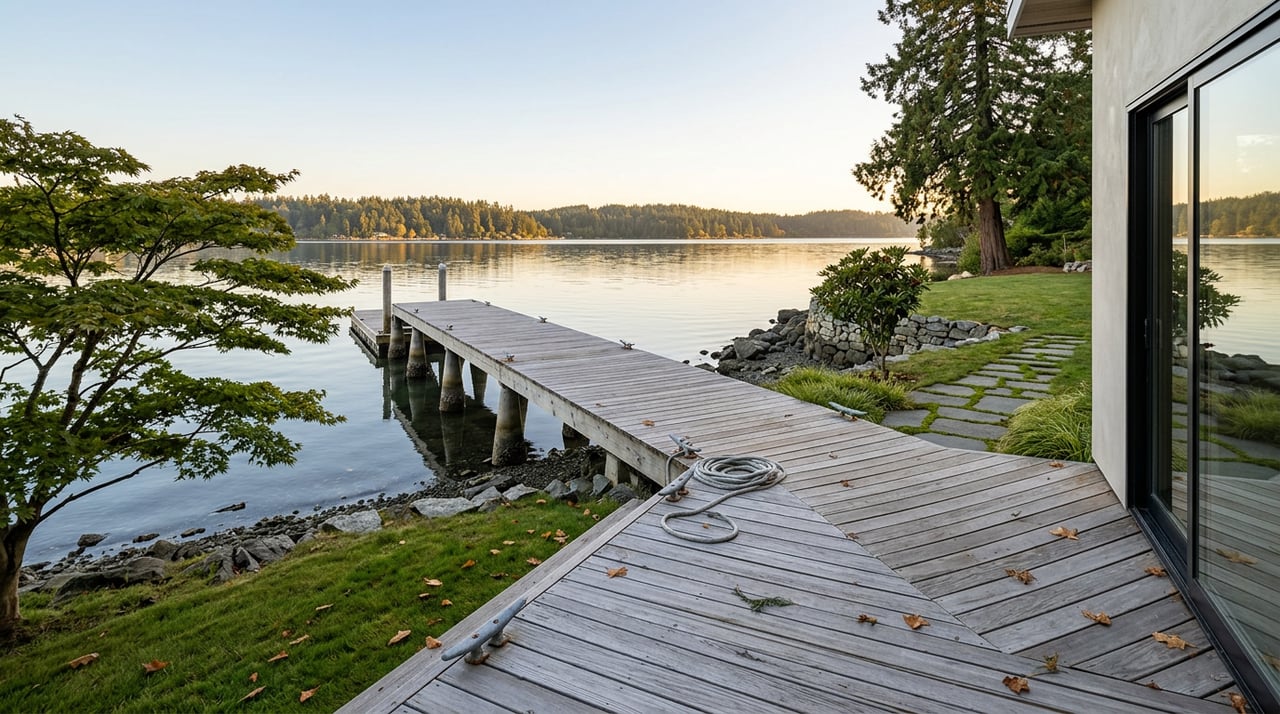
Mercer Island's waterfront tier, where homes with private dock access and unobstructed Lake Washington views trade in the five to twenty million dollar range, isn't going to be meaningfully repriced by a ten-minute train ride to Seattle. Bellevue's Wilburton condos, sitting inside an actively developing corridor with thousands of new units nearby, are playing a genuinely different game.
Where this leaves a relocating buyer
If your priority is the commute, Mercer Island now offers something almost no other Eastside address can match: a short, direct, car-free ride to both downtown Bellevue and Seattle's International District, on a line that runs every eight minutes at peak. That's real, and it's available today.
If your priority is long-term appreciation tied to a neighborhood's ability to grow around new infrastructure, the more responsive bet right now sits in Bellevue's Wilburton, Spring District, and Bel-Red corridor, where the zoning and the pipeline already match the transit investment. Mercer Island's own capacity to grow near its station is still working through a state-mandated planning process that just hit its first legal deadline this summer, with more change phased in through the end of the decade.
Both are legitimate reasons to choose a neighborhood. They're just not the same reason, and conflating them is how a buyer ends up disappointed by a number that was never going to move the way the headlines implied.
If you're weighing Bellevue, Mercer Island, or another Eastside neighborhood against each other and want a read on what a specific address's zoning, permitting history, or station-area development pipeline actually supports, that's the kind of groundwork worth doing before you write an offer. Mary Nelson has spent 14 years and 175 plus transactions building exactly that kind of local read. Let's Connect.